Where Your Leverage Lives - The Modifiable Side of Blood Pressure
"Give me a place to stand, and I will move the earth." — Archimedes, as quoted by Pappus of Alexandria (c. AD 340)
You cut the salt for a month. You read the labels, skipped the chips, asked for no added salt when you ate out. At the end of the month the cuff reads what it always read. A coworker who tried the same thing dropped ten points and will not stop talking about it. The conclusion sits there waiting to be drawn. Lifestyle changes work for other people, not for you.
That conclusion is wrong, and the reason is specific. Salt moves one lever, your blood volume. If the thing pushing your number up was never volume, cutting salt was always going to do nothing for you. You did not fail at it. You aimed at the wrong lever.
That is the whole gap between "lifestyle helps blood pressure" and "lifestyle helps your blood pressure." The first is a slogan. The second needs you to know which of three levers is yours, the volume in the system, the strength of the pump, or the tightness of the pipes, and then which daily habits feed that one. The map for the three levers is its own piece. This one is the next step. Each lever, the handful of inputs that actually move it, and an honest number for how far each can shift the cuff. Honest includes the small ones, because knowing a lever is small for you is how you stop wasting months pulling it.
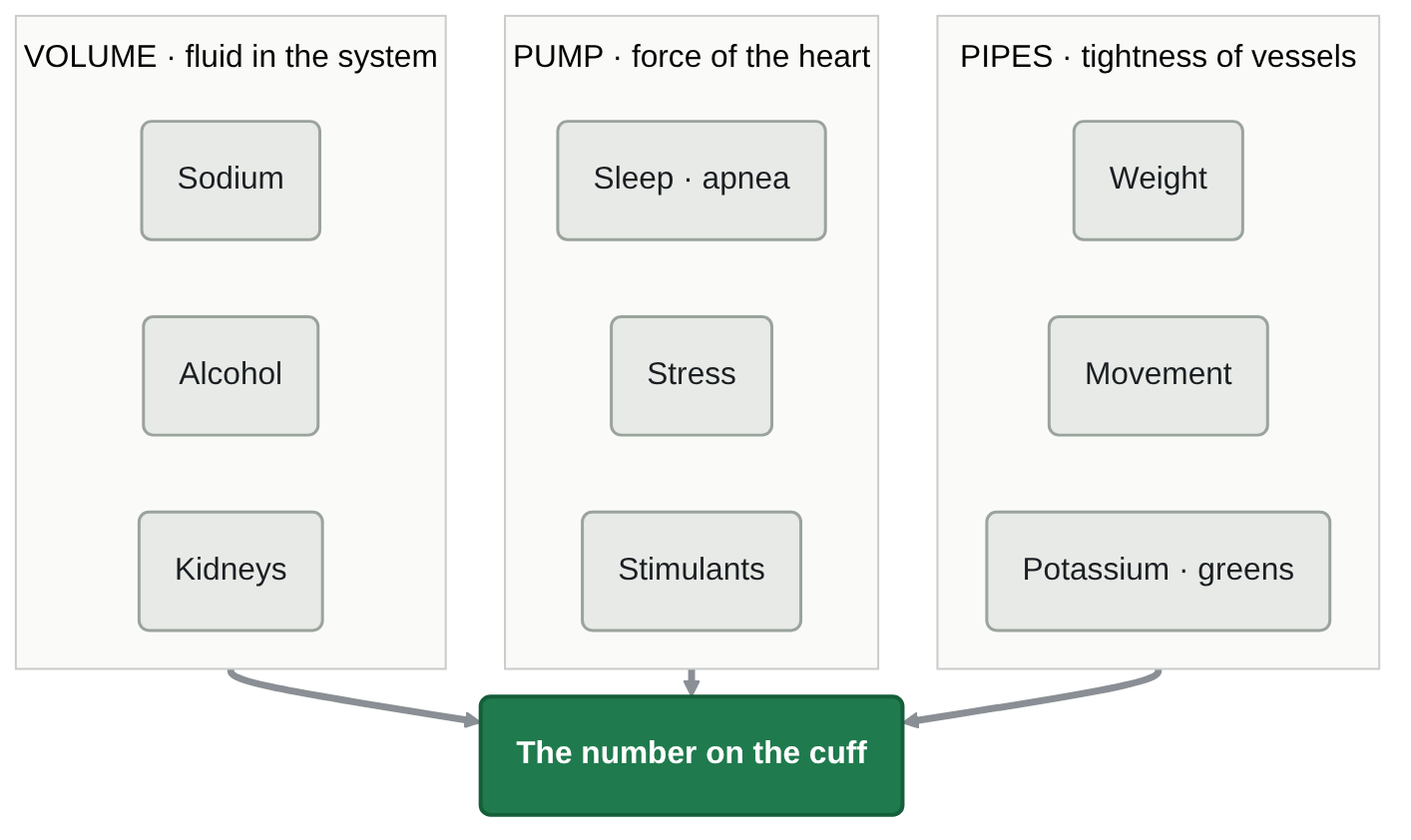
The volume lever is the one salt actually moves
Here is why it worked for the coworker and not for you. How much your number moves when you cut salt varies enormously from person to person, and the trials are clear about who moves most. Cutting daily sodium by about a teaspoon's worth of salt lowers the top number by a few points on average. Older people, people who started with a higher number, and non-white populations all get more of that drop than the average suggests. Anyone outside those groups may get very little, which is why the same experiment can be transformative for your coworker and close to nothing for you.
One detail worth stealing from the trials. Two weeks is not long enough to judge it. Studies running under fifteen days found less than half the blood-pressure effect of longer ones, so a short experiment will underestimate your own response. Give it a month before you decide salt is not your lever. The tendency for some people to respond much more than others has a name, salt sensitivity, and it is an active enough research question to have its own American Heart Association statement.
Alcohol sits on the same lever from the other side. A heavy drinker who cuts intake in half drops the top number by five or six points, and the rough rule is about one point back for every daily drink dropped. The newest guidance leans toward less being better all the way down, with no clean safe threshold.
Volume also swings fast in the short term, down with heat, hard exercise, or a stomach bug, and up slowly over years of high sodium or tiring kidneys. One quiet tell lives in your pulse. If your heart races after a short walk, that points toward low volume rather than away from it, and there is a home test for it in Why Your Heart Races After a Short Walk. The replacement question, and why the convenience-store electrolyte packet is not a free pass, is in Make Your Own Electrolyte Drink - Why the Packet Isn't a Free Pass.
The pump lever answers to sleep, stress, and stimulants
The heart adjusts to demand, and most of the demand is set by how you sleep, how stressed you run, and how much you stimulate it.
Sleep is the biggest input most people ignore. Loud snoring with unrefreshing sleep points at obstructive sleep apnea, where breathing stops and restarts through the night and the heart gets jolted awake each time without you knowing. Treating it lowers blood pressure most in exactly the people whose pressure is still uncontrolled, and barely at all in those already well controlled. Chronically short sleep, under six hours, is its own driver, and lengthening it is worth trying before reaching for another change.
Stress acts here too, and the interventions with the best evidence are the unglamorous ones. A regular mindfulness practice and structured slow breathing move the office number by a few to several points, though they look smaller on round-the-clock monitoring. The device that sells the breathing is not the thing that works. The sitting still and breathing slowly is.
Caffeine is the input people most overestimate. In about half of regular drinkers, tolerance erases the effect entirely. In the other half it leaves a small persistent bump of two or three points. So cutting caffeine is worth a two-week test, and it is the right move for that low-tolerance half, but for most people it is a small lever, not the answer.
The vessel lever has the most handles
This is the lever with the most you can act on without a prescription.
For anyone under forty, body weight is often the single biggest lever available. Each kilogram lost takes roughly a point off the top number, and the effect compounds with larger loss. Daily movement is the workhorse next to it. The standard prescription, 150 minutes a week of moderate aerobic exercise, lowers the top number by five to eight points, and it is dose-responsive, more minutes for more effect, with the returns flattening past 150. Resistance training works too, and the most recent reviews find no clear winner among aerobic, resistance, and combined.
And then the exercise data says something almost nobody has told you. The move with the strongest effect on the number is not running, and it is not lifting. It is isometric work, which means holding a muscle under steady tension instead of moving through repetitions. In the largest analysis available, pooling 270 trials, isometric training ranked first for lowering the top number, averaging around an eight-point drop, and the plain wall squat was the single most effective move in the set. The handgrip version is four two-minute squeezes with a minute of rest between them, three days a week, sitting down. Roughly twenty-four minutes a week of not moving.
The honest caveat is that the isometric trials are generally smaller and shorter than the decades of aerobic research behind walking, so this is not a reason to stop walking. It is a reason to add the cheapest lever on this page, and it is the first thing to reach for if what you are short on is time rather than willingness. The full ranking and the real prescriptions are in The Exercise That Lowers Blood Pressure Most Isn't Cardio.
Two more surprises sit in what you eat. Potassium matters about as much as sodium, because the body is built for a diet where potassium outweighs sodium and the modern plate has that backwards. Vegetables, fruit, beans, and dairy are the easy sources, with real caution in advanced kidney disease, where high potassium turns dangerous and the rules change. And there is the leafy-green pathway, where bacteria living in your mouth turn the nitrate in greens into nitric oxide, the molecule that tells vessels to relax. It is real enough that antibacterial mouthwash can blunt it. The full chain is in Leafy Greens, Nitric Oxide, and the Pipe That Won't Relax.
What this adds up to
Stack the right changes and the trial numbers are not small. Combined lifestyle change has produced top-number drops of ten to fifteen points. The DASH eating pattern alone is worth about seven, and DASH with sodium restriction about eleven, which is roughly what a single blood pressure pill delivers on its own. For scale, every five-point drop in the top number cuts cardiovascular events by around ten percent.
So a starting point of 150 over 95, plus three correctly aimed changes, can plausibly land near 135 over 85 without ever opening the medicine cabinet. Not guaranteed. Not for everyone. Common enough in the trial data that "lifestyle does not work" stops being a defensible position once the levers are aimed right. Even in resistant hypertension, a structured program of exercise, diet, and weight management has hit a twelve-point drop.
If your family history scares you, aim more levers, not fewer
The instinct after a parent's early stroke is to assume the dice are loaded and lifestyle is a rounding error. The data say close to the opposite. Across the population, the absolute benefit of a favorable lifestyle is the same whether genetic risk is high or low, and because high-risk people start higher, the same proportional drop can mean a larger absolute one for them. The honest caveat is that any single change may do a little less against a strong genetic background, which is exactly why the answer is to pull several levers at once instead of betting everything on salt. Gene-score testing is not yet ready to guide any of this in the clinic, and no major guideline recommends it for routine care.
What this looks like at a visit
The audit gives you the working list. The next step is the part most patients skip and most doctors cannot do for them. Track. Log. Bring data to the visit instead of asking the doctor to find the pattern inside fifteen minutes with no history to go on. A two-week diary of cuff readings paired with the lever you were testing that week (cut the salt, added the walk, swapped the second coffee for water, slept the extra hour) is the input the visit was missing in the first place. How to gather it, and how to read your doctor's reasoning when you bring it, is in Bring Your Own Data - What Your Doctor Cannot See.
Do not change or stop a blood pressure medication on your own. Bring the experiment and the readings to the clinician who knows you, and let the dose decisions happen there. And the potassium advice above flips in advanced kidney disease, where loading up on potassium can cause dangerous heart-rhythm problems. If your kidneys are impaired, check before pushing it.
Put this to work. The method is in The Three-Lever Test - How to Read Any Pill, Supplement, or Food Against Your Number, and it is worth running in your own head rather than handing off. Naming which lever a thing pulls is the part that makes you able to read the next one.
References
Sources behind the claims in this piece. Listed at the bottom rather than inline so the prose reads cleanly. Each entry is what actually backs the claim it supports, not adjacent literature.
On salt sensitivity as a named phenomenon (statement, no abstract indexed, cited as a pointer rather than for a figure):
On the volume levers (sodium, alcohol, hydration):
- Effect of dose and duration of reduction in dietary sodium on blood pressure levels: systematic review and meta-analysis of randomised trials. Huang L et al., 2020, BMJ
- Blood Pressure-Lowering Medications, Sodium Reduction, and Blood Pressure. Song J et al., 2024, Hypertension
- Effects of low sodium diet versus high sodium diet on blood pressure, renin, aldosterone, catecholamines, cholesterol, and triglyceride. Graudal NA et al., 2020, Cochrane Database of Systematic Reviews
- Effect of longer term modest salt reduction on blood pressure: Cochrane systematic review and meta-analysis of randomised trials. He FJ et al., 2013, BMJ
- Effect of Dietary Sodium on Blood Pressure: A Crossover Trial. Gupta DK et al., 2023, JAMA
- Salt Sensitivity of Blood Pressure: A Scientific Statement From the American Heart Association. Elijovich F et al., 2016, Hypertension
- Salt Reduction to Prevent Hypertension and Cardiovascular Disease: JACC State-of-the-Art Review. He FJ et al., 2020, JACC
- The effect of a reduction in alcohol consumption on blood pressure: a systematic review and meta-analysis. Roerecke M et al., 2017, Lancet Public Health
- Blood Pressure After Changes in Light-to-Moderate Alcohol Consumption in Women and Men: Longitudinal Japanese Annual Checkup Analysis. Suzuki T et al., 2025, JACC
- Alcohol Intake and Blood Pressure Levels: A Dose-Response Meta-Analysis of Nonexperimental Cohort Studies. Di Federico S et al., 2023, Hypertension
- Alcohol intake reduction for controlling hypertension. Acin MT et al., 2020, Cochrane Database of Systematic Reviews
On the pump levers (sleep, stress, caffeine):
- Effects of CPAP on Blood Pressure Parameter Across Different Severities of Obstructive Sleep Apnoea: A Meta-Analysis. Benning L et al., 2025, Journal of Sleep Research
- Effect of CPAP therapy on blood pressure in patients with obstructive sleep apnoea: a worldwide individual patient data meta-analysis. Pengo MF et al., 2025, European Respiratory Journal
- Benefits of continuous positive airway pressure on blood pressure in patients with hypertension and obstructive sleep apnea: a meta-analysis. Shang W et al., 2022, Hypertension Research
- Sleep extension and metabolic health in male overweight/obese short sleepers: A randomised controlled trial. Hartescu I et al., 2022, Journal of Sleep Research
- The Association Between Sleep Duration and the Risk of Hypertension: A Systematic Review and Meta-analysis of Cohort Studies. Qi J et al., 2025, Journal of General Internal Medicine
- Effect and Acceptability of Mindfulness-Based Stress Reduction Program on Patients With Elevated Blood Pressure or Hypertension: A Meta-Analysis of Randomized Controlled Trials. Lee EKP et al., 2020, Hypertension
- Effect of Adapted Mindfulness Training in Participants With Elevated Office Blood Pressure: The MB-BP Study: A Randomized Clinical Trial. Loucks EB et al., 2023, Journal of the American Heart Association
- Efficacy of device-guided breathing for hypertension in blinded, randomized, active-controlled trials: a meta-analysis of individual patient data. Landman GW et al., 2014, JAMA Internal Medicine
- Association between greenspace and blood pressure: A systematic review and meta-analysis. Zhao Y et al., 2022, Science of the Total Environment
- Blood pressure response to chronic intake of coffee and caffeine: a meta-analysis of randomized controlled trials. Noordzij M et al., 2005, Journal of Hypertension
- Blood pressure response to caffeine shows incomplete tolerance after short-term regular consumption. Lovallo WR et al., 2004, Hypertension
- Cardiovascular symptoms affect the patterns of habitual coffee consumption. Hyppönen E, Zhou A, 2021, American Journal of Clinical Nutrition
- The effect of coffee on blood pressure and cardiovascular disease in hypertensive individuals: a systematic review and meta-analysis. Mesas AE et al., 2011, American Journal of Clinical Nutrition
On the vessel levers (weight, movement, potassium, nitric oxide):
- Effects of aerobic exercise on blood pressure in patients with hypertension: a systematic review and dose-response meta-analysis of randomized trials. Jabbarzadeh Ganjeh B et al., 2024, Hypertension Research
- Resistance exercise has an antihypertensive effect comparable to that of aerobic exercise in hypertensive patients: a meta-analysis of randomized controlled trials. Morita H et al., 2025, Hypertension Research
- Exercise characteristics and blood pressure reduction after combined aerobic and resistance training: a systematic review with meta-analysis and meta-regression. Schneider VM et al., 2023, Journal of Hypertension
- Effects of High-Intensity Interval Training Versus Moderate-Intensity Continuous Training On Blood Pressure in Adults with Pre- to Established Hypertension: A Systematic Review and Meta-Analysis of Randomized Trials. Costa EC et al., 2018, Sports Medicine
- Resistance Exercise Training in Individuals With and Without Cardiovascular Disease: 2023 Update: A Scientific Statement From the American Heart Association. Paluch AE et al., 2024, Circulation
- Exercise training and resting blood pressure: a large-scale pairwise and network meta-analysis of randomised controlled trials. Edwards JJ et al., 2023, Br J Sports Med
- Effect of home-based isometric handgrip exercise with a commercially available device on blood pressure in older adults with hypertension: A randomized controlled trial. Champaiboon J et al., 2026, PLoS One
- Exercise for Primary and Secondary Prevention of Cardiovascular Disease: JACC Focus Seminar 1/4. Tucker WJ et al., 2022, JACC
- Effect of changes in potassium intake on blood pressure: a dose-response meta-analysis of randomized clinical trials (2000-2024). Granal M et al., 2025, Clinical Kidney Journal
- Effect of increased potassium intake on cardiovascular risk factors and disease: systematic review and meta-analyses. Aburto NJ et al., 2013, BMJ
- Association between the Urinary Sodium to Potassium Ratio and Blood Pressure in Adults: A Systematic Review and Meta-Analysis. Ndanuko RN et al., 2021, Advances in Nutrition
- Oral potassium supplementation for management of essential hypertension: A meta-analysis of randomized controlled trials. Poorolajal J et al., 2017, PLoS One
On combined lifestyle change and the achievable totals:
- Nonpharmacologic Interventions for Reducing Blood Pressure in Adults With Prehypertension to Established Hypertension. Fu J et al., 2020, Journal of the American Heart Association
- Treatment of Hypertension: A Review. Carey RM et al., 2022, JAMA
- 2025 AHA/ACC Guideline for the Prevention, Detection, Evaluation, and Management of High Blood Pressure in Adults. Jones DW et al., 2025, JACC
On genetic risk and lifestyle:
- Genetic Predisposition to High Blood Pressure and Lifestyle Factors: Associations With Midlife Blood Pressure Levels and Cardiovascular Events. Pazoki R et al., 2018, Circulation
- Interactions Between Enhanced Polygenic Risk Scores and Lifestyle for Cardiovascular Disease, Diabetes, and Lipid Levels. Ye Y et al., 2021, Circulation: Genomic and Precision Medicine
- Associations of family history of hypertension, genetic, and lifestyle risks with incident hypertension. Takase M et al., 2025, Hypertension Research
- Blood Pressure Genetic Risk Score Predicts Blood Pressure Responses to Dietary Sodium and Potassium: The GenSalt Study (Genetic Epidemiology Network of Salt Sensitivity). Nierenberg JL et al., 2017, Hypertension
- Genetic Susceptibility, Dietary Protein Intake, and Changes of Blood Pressure: The POUNDS Lost Trial. Sun D et al., 2019, Hypertension
- Genome-wide analysis in over 1 million individuals of European ancestry yields improved polygenic risk scores for blood pressure traits. Keaton JM et al., 2024, Nature Genetics
- Clinical utility and implementation of polygenic risk scores for predicting cardiovascular disease: an ESC clinical consensus statement. Schunkert H et al., 2025, European Heart Journal
- Polygenic Risk Scores for Cardiovascular Disease: A Scientific Statement From the American Heart Association. O'Sullivan JW et al., 2022, Circulation
Comments ()