Listening to Lungs at Home
"It is the province of knowledge to speak, and it is the privilege of wisdom to listen." — Oliver Wendell Holmes Sr.
A stethoscope costs less than a tank of gas, and for a curious parent it can be a genuinely interesting window, sometimes a parent really can notice a new soft wheeze before the child reports any obvious symptoms. But be clear about where this sits before you buy one. Listening through a stethoscope is an optional bonus, not the skill that keeps a child safe. The skill that keeps a child safe is watching how they breathe: the rate, the effort, whether they can talk in full sentences, their color, how they respond to the rescue inhaler (What Working to Breathe Looks Like). Home listening can add a small early hint on top of that. What it can never do is tell you a child is fine.
That last point is the whole safety boundary, not a footnote. Cheap stethoscopes and untrained ears are unreliable, noise from the upper airway is easily mistaken for the lungs, and, most dangerous of all, a badly obstructed chest can go quiet, so a child in real trouble can have less to hear, not more. Absence of a wheeze never means absence of a problem. Use listening to add information on the good days and to sharpen the next conversation with the doctor, never to talk yourself out of acting when the child looks like they are working to breathe.
What makes it learnable at home is the very thing that makes it hard in a clinic. A doctor learns lungs across hundreds of different chests. A parent learns one child's lungs, the same ones every day. That familiarity helps you notice when something has changed from this kid's normal, which is the real value. Be honest about its limit, though: knowing a sound has changed is not the same as knowing what the change means, and listening to the same chest over and over can lock in a wrong impression as easily as a right one. The familiarity is a head start on noticing, not a shortcut to interpreting.
Learn normal before you chase abnormal
The whole skill rests on knowing this child's baseline, so the listening starts on the healthy days, not the scary ones. A couple of weeks of two-minute listens while your kid is well builds your ear for the ordinary soft sound of air moving, and only against that does the abnormal stand out. Learn normal first, deliberately, before you go hunting for anything else.
Where and how to listen
The technique is almost nothing once you see it:
- Quiet room, child sitting up, calm (a crying child drowns everything out).
- Use the diaphragm, the flat side of the stethoscope, on bare skin, not over clothes.
- Place it on the upper back, then the matching spot on the other side, so you can compare left against right.
- Work top to bottom, a few spots down each side.
- Listen through a full breath in and a full breath out, because most asthma sounds live on the way out.
- Write what you hear into the journal.
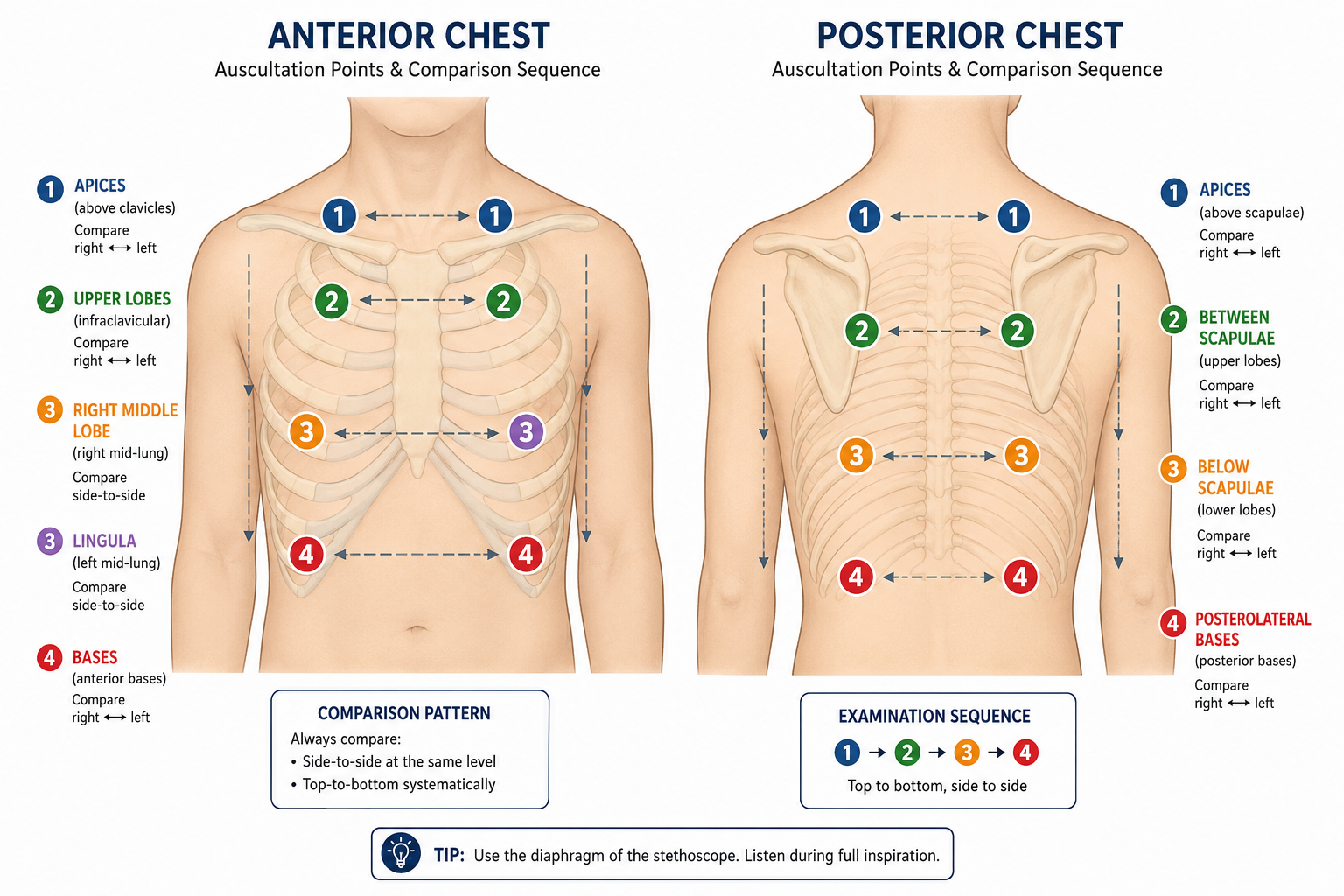
The map below shows the standard listening spots on both the front and the back. For home listening you mainly use the back, working from the top of the lungs down to the bases and comparing left against right at each level. You do not need to hit every point a clinician would. What matters is the pattern, the same spot on both sides, working top to bottom.
The sounds that matter
A labeled clip teaches the difference faster than any sentence, and the recognition has to become automatic before it is any use in a real moment. Each player below holds a few real recordings of that sound, every one taken from a child, so you hear the range rather than a single example. Play each a couple of times until you can pick it out.
Normal breath sounds: soft, breezy air moving in and out, no extra noise on top. The clip gives you the general idea, but this is the one to learn on your own child, over and over on the well days, because every child's normal is a little different and the recording cannot stand in for it.
Wheeze: a high, musical whistle, usually on the way out. The early asthma sound, soft and early before it is loud and late.
Crackles: short popping or clicking sounds, like crumpling cellophane. They have several possible causes, so they are worth reporting to the clinician, not diagnosing at home.
Rhonchi: a low, coarse, snore-like rattle that often changes a little after a cough. Note what you heard rather than trying to pin down its cause.
Stridor: a harsh, high noise on the way in, not out. This is different and more urgent (see the red flag below).
Audio: pediatric lung sounds from the SPRSound open respiratory sound database (Shanghai Jiao Tong University), CC BY 4.0. Clips converted to MP3 for playback.
Stridor, a harsh noise when your child breathes in, is an upper-airway sound, not a typical asthma wheeze. Stridor at rest, a short grunt at the end of each breath, blue or gray color, trouble speaking or drooling, exhaustion, or obvious hard work to breathe needs urgent assessment, and severe distress needs emergency help now. This is the action plan's red zone, not a journaling moment. See What Working to Breathe Looks Like.
One way to sharpen your ear: when an unusual sound is actually present during a visit, ask the clinician to describe what they hear and compare it against what you noticed. A routine appointment cannot validate weeks of your home classifications, but a side-by-side on a real, present sound is genuinely useful, and it is the honest version of calibrating against an expert. None of this turns you into a diagnostician, and none of it replaces watching how your child is breathing or calling the doctor when something feels wrong. It does one narrower thing: it can turn "this sounds different from his normal" into a sentence you can say with some confidence at the next visit, which is more useful to a clinician than "I'm worried." That is the whole of it, a sharper observation on the good days, not an early-warning system to act on alone. So if you take it up, start on the well days, learn normal first, calibrate with the clinician, and keep the steps handy: home listening steps.
Comments ()