What Working to Breathe Looks Like
"The eye sees only what the mind is prepared to comprehend." — Robertson Davies, Tempest-Tost
Picture a busy room. A birthday party, the back of a classroom, the edge of a practice. A child has gone a little quiet, sitting out, breathing fast, the skin tugging in at the base of the neck with each breath. Every adult in the room glances over and reads the same thing: tired, or sulking, or done for the day. That is what it looks like, if you have never been taught the other thing it can be.
The hard truth underneath that scene is this. The person standing next to a child when they first start to go downhill is almost never a doctor. It is a parent, a grandparent, a coach, a teacher, the host of a sleepover. We have made non-clinical adults the first line of detection for a child's breathing, and then handed almost none of them the one skill the job requires: knowing what a child struggling to breathe actually looks like.
This piece is about closing that gap. Not a checklist to memorize under stress, you will not remember it then. A sight picture you learn once, on a calm day, so it jumps out at you later. The same way you learn to recognize a face, or the sound of your own child's cough.
The signs are visible. The problem is nobody learned to see them.
Start with the encouraging part: when a child is in real respiratory trouble, the body shows it, plainly, in ways anyone can be taught to read. In a study of 2,722 infants, a small set of signs predicted which ones would need escalated, hospital-level care, and when none of those signs were present, only about one child in two hundred needed escalation. The signs work. The information is on the surface.
The reason it gets missed is not negligence, it is that no one was ever shown the picture. In a separate 2026 survey of more than 2,700 caregivers, fewer than one in four could adequately recognize the respiratory red-flag signs, and the ones they missed most were the dangerous, quiet ones, like a child breathing too slowly or with dangerously low oxygen. The same research found the gap is fixable: caregivers with more health education recognized far more, and teaching reliably moved the number. This is a learnable skill, not a talent.
What working-to-breathe actually looks like
Here is the picture, building from subtle to severe. Learn the order, because the order is the urgency.
First, the early stuff. Breathing faster than usual, and pulling out of play to do it. A child who stops running around to concentrate on breathing is telling you something.
Then the signs of effort. Retractions (the skin sucking inward between the ribs, under the ribs, or at the soft hollow at the base of the neck with each breath) mean the child is recruiting extra muscle just to move air. Nasal flaring (the nostrils widening with each breath) is the same story on the face. In the research these signs of increased work of breathing are among the most useful a non-specialist can spot.
Then the ominous ones, the signs that the picture has turned serious. Grunting (a short sound pushed out with each breath, the body straining to hold the small airways open) is one to take seriously every time. A child who goes quiet and still after being agitated is not necessarily calming down, exhaustion can look like peace. Being unable to finish a sentence, or for a younger child to cry a full cry, is a marker of a severe flare. And cyanosis (a blue or gray tinge to the lips, gums, or fingertips) means the blood is not carrying enough oxygen, and it is an emergency.
No single one of these is the whole answer, and that is the point. You are not waiting for one perfect sign. You are watching a picture assemble, and the more of it that is present, the less time you have.
Here is the same picture as a quick scan, to fix it in your eye now and re-check it later:
| 🟡 Early | Breathing faster than usual. Pulling out of play to breathe. |
| 🟠 Working at it | Skin sucking in at the neck, or between and under the ribs (retractions). Nostrils flaring with each breath. |
| 🔴 Go now | Grunting with each breath. Can't finish a sentence or a full cry. Gone quiet and still after being agitated. Blue or gray lips, gums, or fingertips. |
Keep that on the fridge as part of the printable action plan, which opens with this sight-picture, so any caregiver in the house can match what they see to what to do.
Some of these signs have a sound, not just a look. To learn what grunting, a wheeze, and the breathing-in harshness of stridor actually sound like, Listening to Lungs at Home walks through each, so your ear learns them on a calm day too.
Trust a real change from normal
There is one more signal, and it is one you already have. The research on this is genuinely striking, so it is worth stating plainly: a caregiver's sense that this is different, something is wrong is not anxiety to be talked down. It is data, and good data.
In a large 2025 hospital study, when a caregiver said they were worried their child was getting worse, that worry was more strongly associated with the child ending up in intensive care than any abnormal vital sign was, and it often showed up first, a median of about seven hours before the measurements caught up. An older line of research found that a parent's sense that this illness is different from the others was one of the single strongest red flags for serious illness in a child, stronger than most of the things a clinician measures.
Why would a parent's gut beat a machine? Because you are not reading vital signs, you are reading your own child against the version of them you have memorized. Research on how parents actually judge severity found they go by deviation from normal, the activity, the feeding, the smile, the things only someone who knows this child could notice. You are picking up the change before it is large enough to measure. That instinct is a sensor. Use it.
The escalation ladder
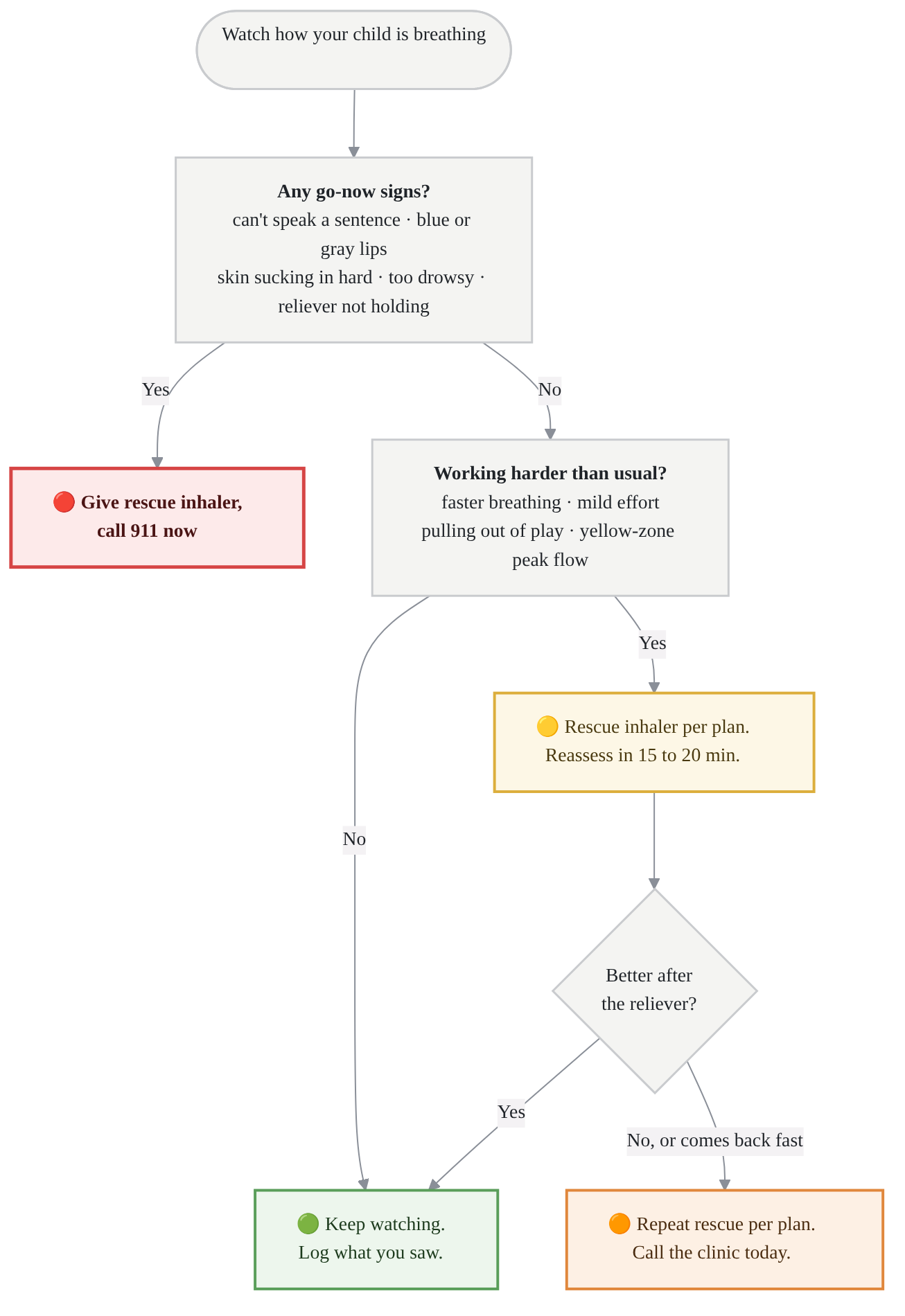
Recognition is only useful if it connects to an action. Tie the sight picture to three rungs, and let your child's written action plan and peak-flow zones fill in the exact numbers.
Rung one, rescue and watch. Early signs, faster breathing, a yellow-zone peak flow, mild effort. This is the action plan's yellow zone: give the rescue inhaler as the plan directs, and watch closely to see whether the child climbs back toward normal or keeps sliding.
Rung two, call today. Signs that are not letting up, or that recur quickly after the rescue inhaler, or a child who is clearly working harder than a yellow zone should look. Call the clinic and be seen.
Rung three, go now. The bottom of the ladder is not a judgment call to agonize over, it is a short list that overrides everything else. The guideline thresholds that define an emergency-level flare in a child are concrete:
- oxygen below about 92 percent,
- peak flow under half of the child's personal best,
- or no real improvement after three rounds of the rescue inhaler over an hour.
Alongside the numbers, the visible go-now signs are the severe end of the sight picture above, spelled out in the warning just below.
Call emergency services or go straight to the nearest emergency department if a child has any one of these:
- Severe difficulty breathing, or grunting with each breath.
- Lips, gums, or skin turning blue or gray.
- Unable to speak, cry, or drink because of the breathing.
- Too drowsy, confused, or hard to wake.
- Chest sucking in deeply with each breath.
- The rescue inhaler is not working, or wears off within a couple of hours.
Any one is enough. Do not wait to see if it passes.
A child with a history that raises the stakes, a previous intensive-care admission, a recent hospitalization, heavy rescue-inhaler use, or a food allergy alongside the asthma, earns a lower threshold for going in. When in doubt with a child like that, go.
That is the whole skill. Not treatment, recognition. Learning the picture once buys you the thing that matters most in a flare, which is acting a few minutes earlier than you otherwise would have.
References
Sources behind the claims in this piece. Listed at the bottom rather than inline so the prose reads cleanly. Each entry is what actually backs the claim it supports, not adjacent literature.
On which visible signs predict that a child needs escalation:
On a caregiver's "something is wrong" outperforming the vital signs, and how parents read severity:
- Association Between Caregiver Concern for Clinical Deterioration and Critical Illness in Children Presenting to Hospital: A Prospective Cohort Study. Mills E et al., 2025, Lancet Child & Adolescent Health
- Diagnostic Value of Clinical Features at Presentation to Identify Serious Infection in Children in Developed Countries: A Systematic Review. Van den Bruel A et al., 2010, Lancet
- Parental Assessment of Disease Severity in Febrile Children Under 5 Years of Age: A Qualitative Study. Kuijpers DL et al., 2021, BMJ Open
On the recognition gap in caregivers and that teaching closes it:
- Caregiver Awareness of Pediatric Respiratory Red-Flag Signs and Emergency Activation Intentions: A Province-Wide Cross-Sectional Study. Li L & Li Z, 2026, Frontiers in Medicine
- Feasibility and Reliability of Telemedicine Examinations for Respiratory Distress in Children: A Pilot Study. Florin TA et al., 2024, Journal of Telemedicine and Telecare
On the objective thresholds that make a flare an emergency:
- Acute Asthma Exacerbations: Management Strategies. Dabbs W et al., 2024, American Family Physician
- Asthma. Papi A et al., 2018, Lancet
National guideline thresholds referenced in prose are from the NAEPP Expert Panel Report 3 and the GINA strategy reports.
Comments ()